You’ve decided to build with concrete. Smart choice. Now comes the more challenging part: finding the right plans. Concrete homes should stand the test of time, and the plan you start with makes all the difference.
Concrete homes require different blueprints than wooden houses. You can’t just grab any floor plan and swap the materials.
Most people don’t realize this until they’re already talking to contractors. Then they realize their dream design is missing critical information.
Without the right concrete home plans, you’ll face delays, change orders, and budget surprises. You’ll need specialized plans and experienced builders. The process takes more time upfront. But the payoff is real.
What Are Concrete Homes?
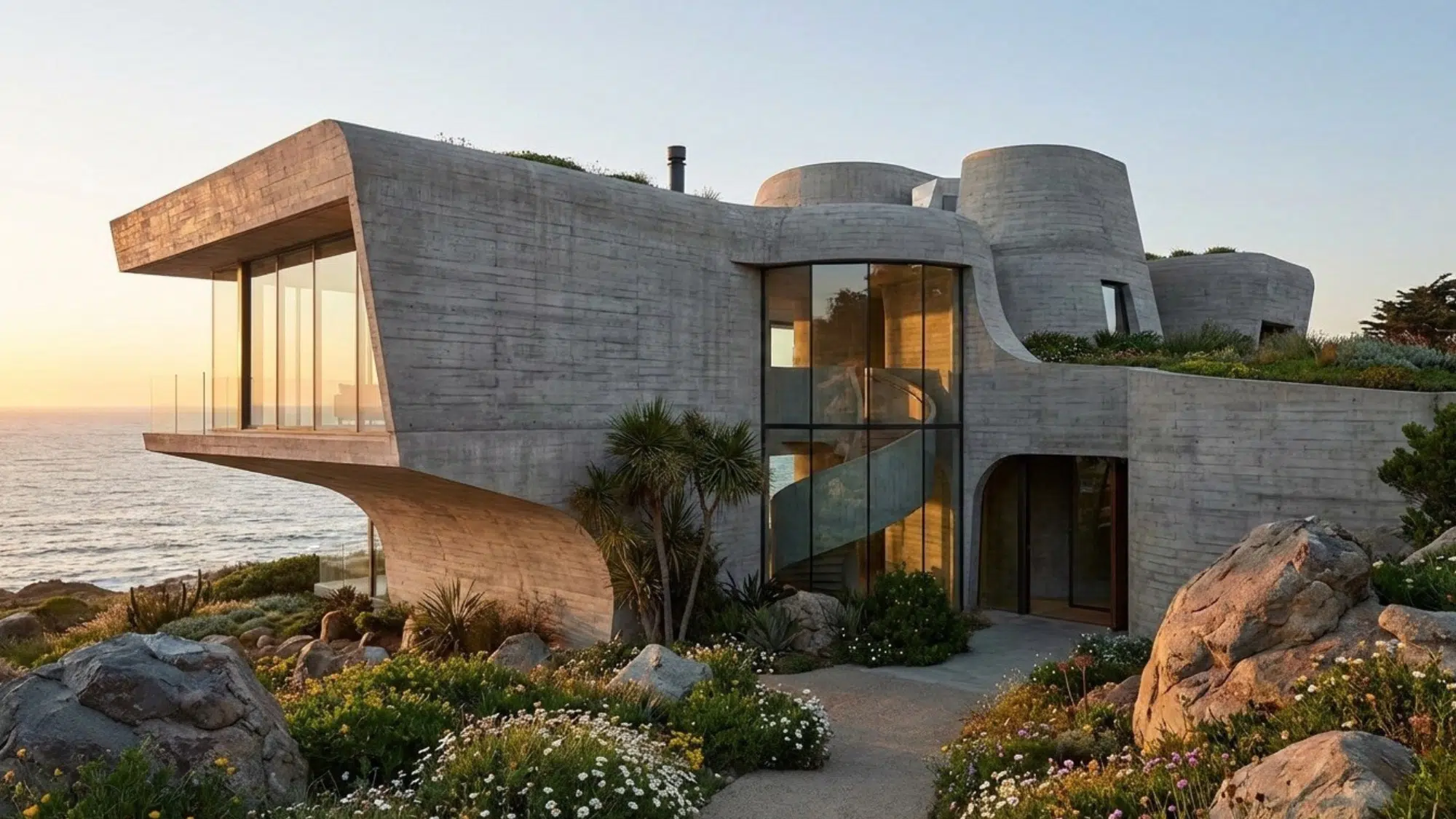
Concrete homes often look like any other house from the street, so you may not notice anything different at first.
The main difference is in the structure: these homes use concrete walls as the primary load-bearing system rather than wood studs and beams.
Most residential concrete homes are built using ICF, precast panels, or CMU block.
With ICF, foam forms stack like large blocks, then get filled with concrete and stay in place as insulation.
Precast panels are factory-made, delivered to the site, and set with a crane, while CMU uses concrete blocks laid with mortar, reinforced with steel, and filled cores for strength.
Each method changes planning, pricing, and build speed, but all create a strong, long-lasting shell.
Why Concrete Homes Are Worth It: Benefits
Concrete homes offer more than just strength. From day-to-day comfort to long-term durability, the benefits show up in how the house performs, how it feels to live in, and how much work it needs over time.
- Built to Last Longer: Concrete resists rot, termites, and mold, and it doesn’t warp like wood. That means fewer structural repairs as the home ages.
- More Stable Comfort: Concrete’s thermal mass helps smooth temperature swings, so rooms feel more consistent, especially when paired with sound insulation and smart window placement.
- Stronger in Storms and Fire: Reinforced concrete handles high winds and flying debris better than wood framing, and it’s naturally fire-resistant, adding absolute safety in severe conditions.
- Lower Maintenance over Time: You’re less likely to deal with rot, pest damage, warping, or recurring patch-and-paint cycles that are common with wood.
- Cleaner Indoor Air (with Planned Ventilation): Concrete homes tend to be tighter, reducing drafts and the entry of outside pollutants. Add proper mechanical ventilation to keep fresh air circulating.
Together, these benefits show why many homeowners view concrete as a long-term investment. The upfront planning takes more effort, but the payoff is lasting durability, comfort, and peace of mind.
What Are the Drawbacks of Concrete Homes?
Concrete construction comes with trade-offs worth understanding. The biggest is the upfront cost. You’ll typically pay 10 to 20 percent more than for wood-frame construction.
Finding experienced concrete builders can be challenging in some areas, leading to higher bids or longer waits.
Construction also takes longer since concrete needs days to cure between significant steps.
Changes during the build are expensive because hardened concrete is difficult to modify.
Remodeling later requires more planning and effort than remodeling a wood-frame home. Utility work requires careful planning upfront, since drilling through solid walls isn’t simple.
However, many homeowners find these drawbacks acceptable given the long-term benefits. The upfront extra cost is often offset by lower maintenance costs, energy savings, and insurance discounts over the years you own the home.
Concrete House Plan and Design Examples
Concrete house plans aren’t one-size-fits-all. The wall system you choose can better support specific layouts and finishes than others, so it helps to pick a method that fits your design goals, climate, and your local builder’s experience.
Some of the plan styles that pair well with concrete construction.
1. Courtyard Plan (Privacy-Focused)
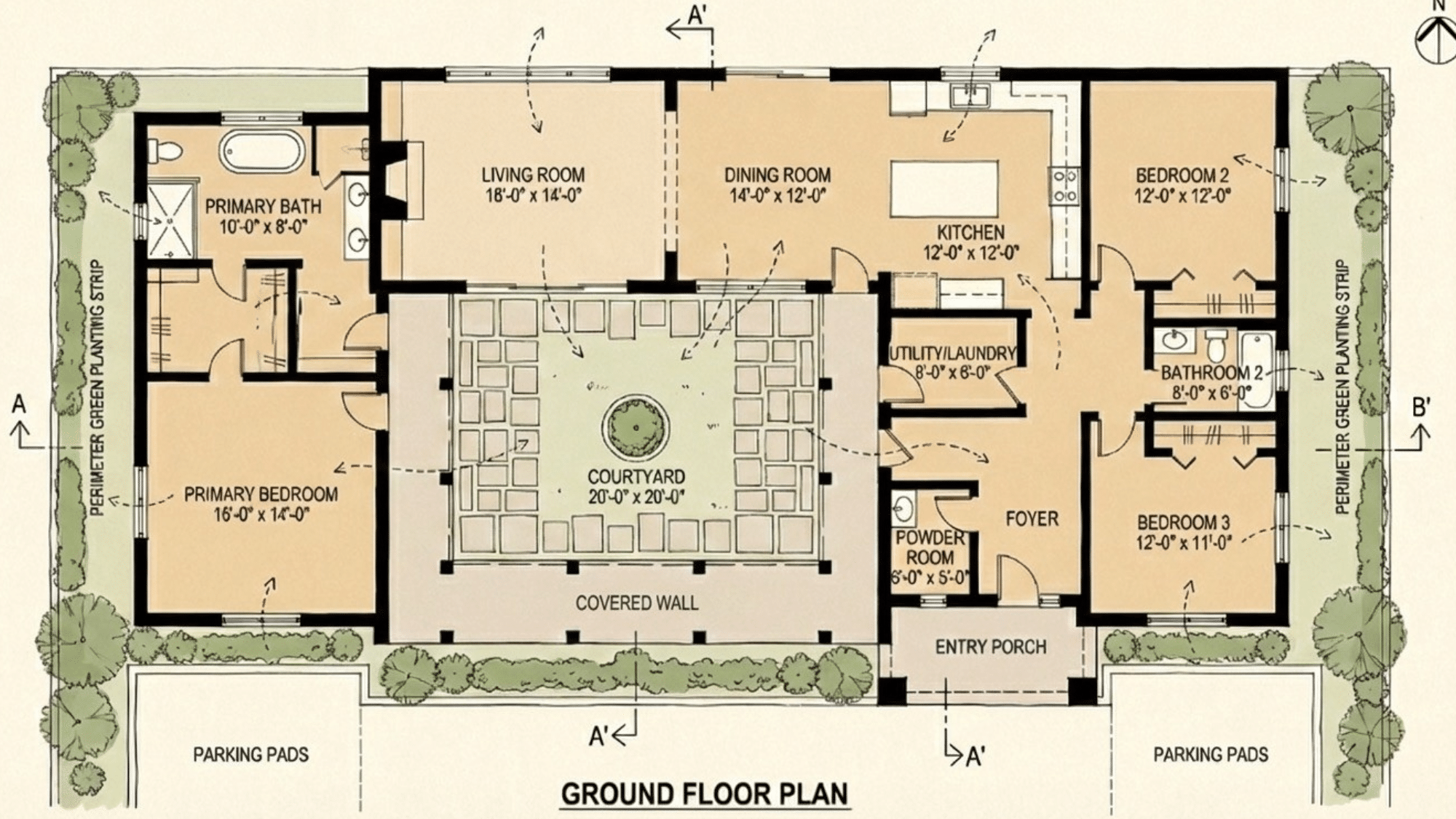
This is a ground-floor plan built around a central open courtyard. You enter from the front entry porch into a small foyer. A powder room sits nearby.
The main living areas are along the top side. The living room connects to the dining room. The kitchen is next to the dining room, with a utility room and a laundry room nearby.
The primary bedroom is on the left side. It has a nearby primary bath.
Two more bedrooms are on the right side. They share a second bathroom off the hall.
A covered walkway runs along the bottom edge of the courtyard. Parking pads are shown at both front corners, with planting strips along the outer sides.
2. Modern Open Plan with Large Glass Walls
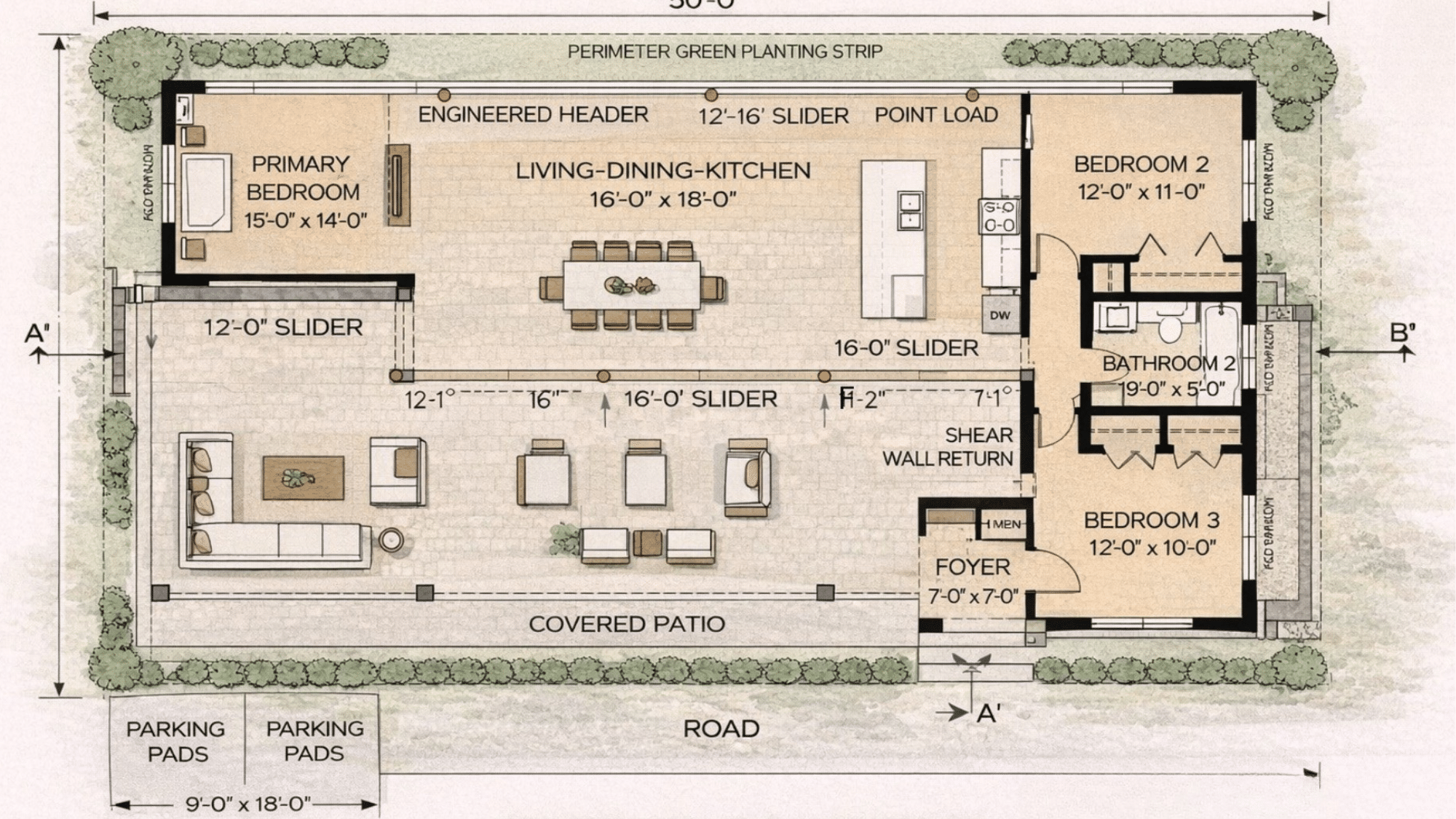
This is a ground-floor plan for a modern, open-plan home.
You enter from the left side into the main living area. The center space is one large great room that combines the kitchen, dining, and living areas.
The kitchen has an island and a pantry nearby, and sliding doors along the top wall open to a covered patio.
The bedrooms are grouped on the right side. Bedroom 1 has its own bath and a closet. Bedrooms 2 and 3 are near a second bath, with extra closets and a small utility space in the hall.
A covered porch runs along the bottom front of the house. Parking pads are shown on the lower left. A north arrow and scale bar are also included.
3. Compact Single-Story Plan (Simple and Efficient)
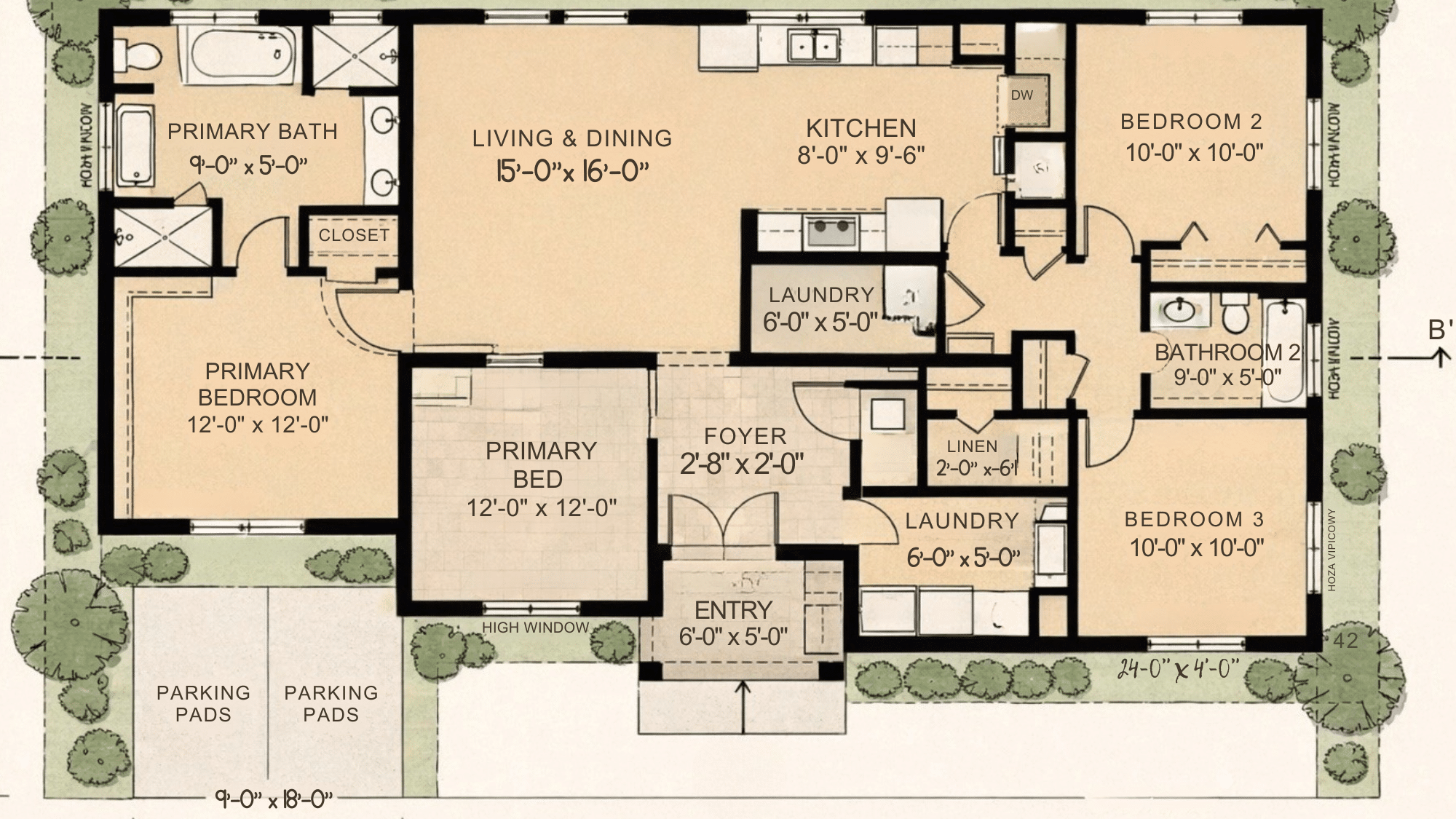
This is a compact ground-floor plan with the main living space in the center.
You enter from the bottom into a small entry and foyer. From there, you step into a combined living and dining area. The kitchen is to the upper right, with a small laundry room nearby.
The primary bedroom is on the left side. It has a nearby closet and a primary bath in the top-left corner.
Two more bedrooms are on the right side. Bedroom 2 is in the top-right corner. Bedroom 3 is in the bottom-right corner. They share a second bathroom off the hall. Parking pads are shown at the bottom left.
Green planting strips and a few high windows are marked around the outside.
4. L-Shaped Plan (Protected Outdoor Zone)
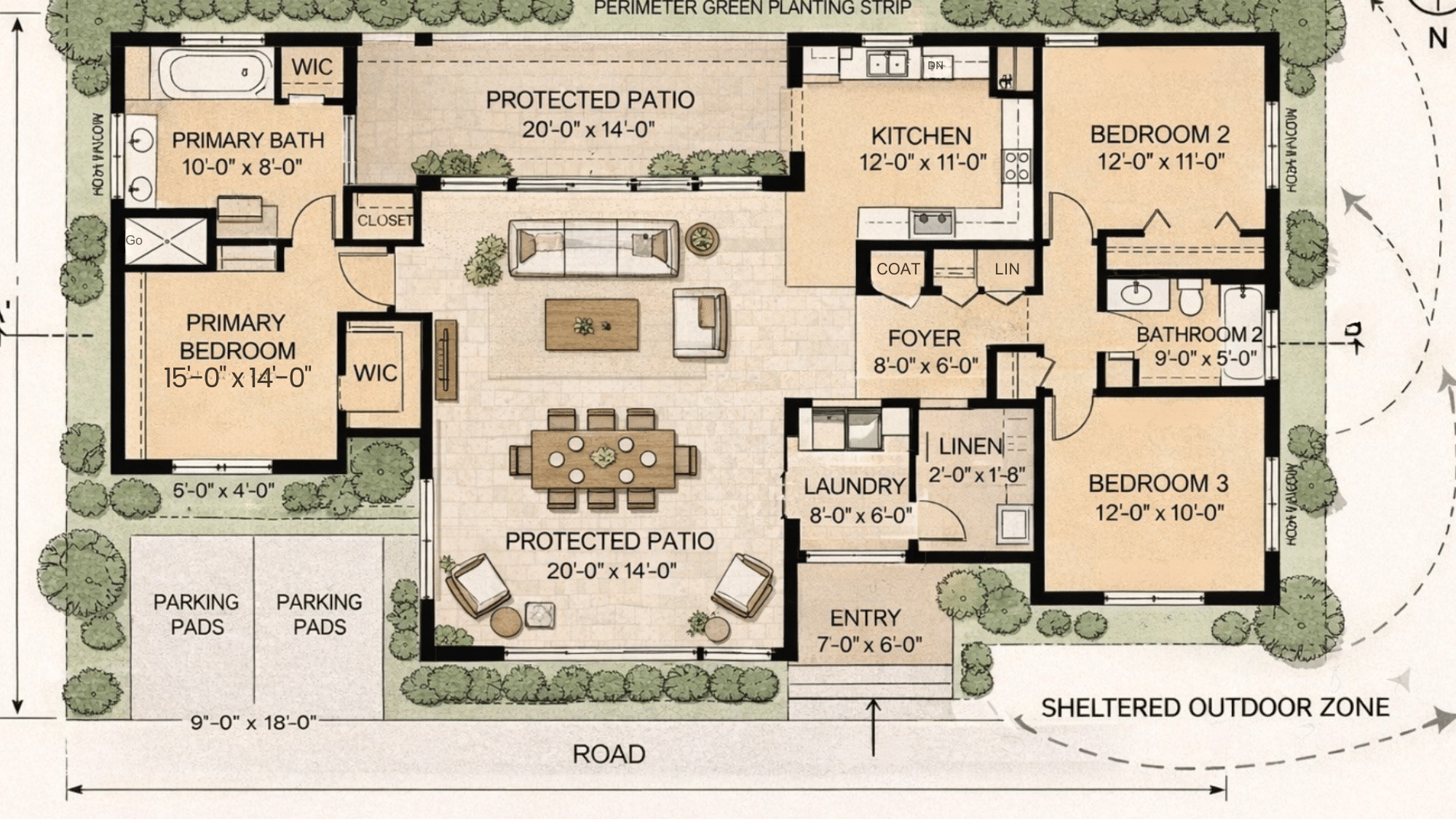
This ground floor plan is shaped like an L and wraps around two protected patios.
You enter from the bottom into an entry and a small foyer. A coat closet and linen storage are located near the entrance.
The center of the home is one open living and dining space. Large openings connect this area to the protected patios, which work like outdoor rooms.
The kitchen is on the upper right side. It is close to the foyer for easy drop-off after shopping. The primary bedroom is on the left side. It has a walk-in closet and a private bath.
Bedrooms 2 and 3 are on the right side. They share a second bathroom off the hall.
A laundry room sits near the entry. Parking pads are shown in the lower left, with planting strips along the perimeter and a sheltered outdoor zone on the right.
5. Coastal/Hurricane-Zone Plan (Storm-Ready)
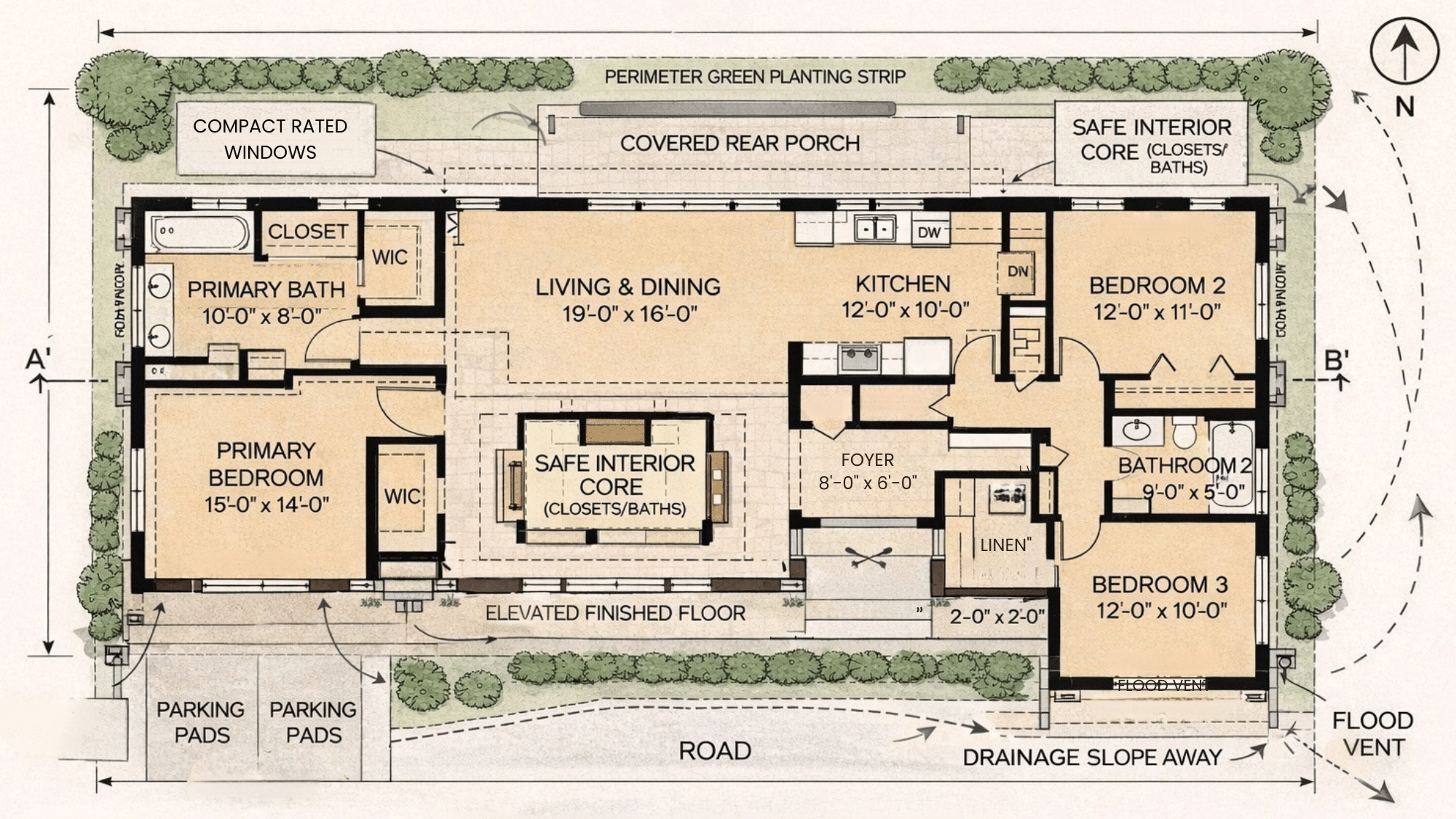
This is a ground-floor plan for a storm-ready coastal home.
You enter from the bottom into a small porch and foyer. The foyer connects to an open living and dining area in the center. The kitchen sits to the right of this space.
The primary bedroom is on the left side with a walk-in closet and a private bath. Bedrooms 2 and 3 are on the right side and share a second bathroom.
Several storage areas are grouped near the foyer, including coat and linen closets. A safe interior zone is shown near the middle, consisting of closets and baths set back from exterior walls.
A covered rear porch runs along the top.
6. Split-Level or Hillside Plan
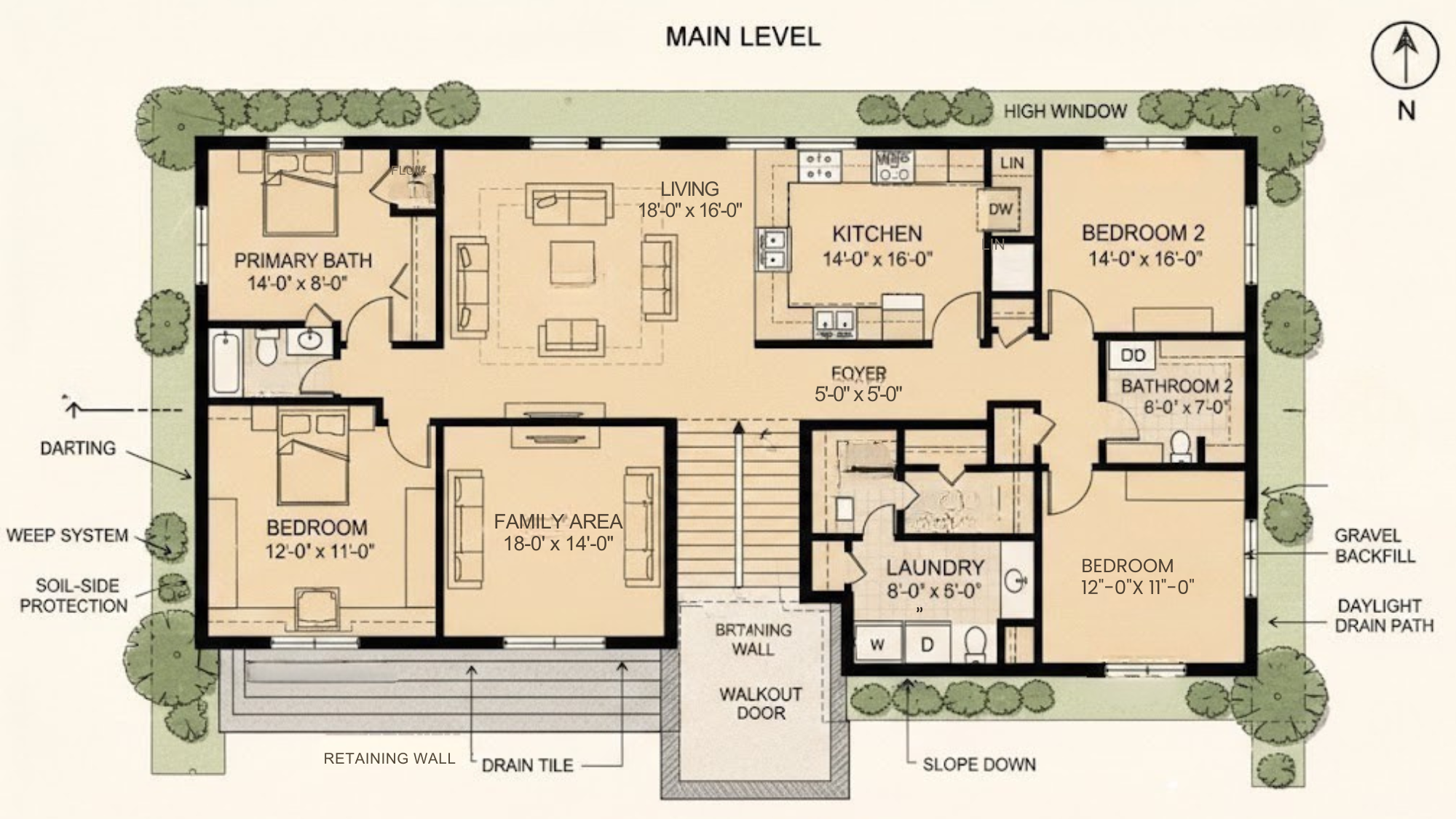
This is a split-level hillside home plan. It shows two floors stepped down the slope. The upper level is the main living area. It has an open living and dining space in the middle, with the kitchen next to it.
The primary bedroom and primary bath are on the left side. Bedroom 3 and a shared bathroom are on the right side. A small foyer and covered entry sit near the center.
The stairs reach the lower level. It includes Bedroom 2, a family room, and a large unfinished storage area.
The site notes show the hill conditions. Retaining walls are marked on both sides, and arrows show the ground sloping down around the home. A lower patio is also shown near the family room.
7. Farmhouse Exterior with A Concrete Shell
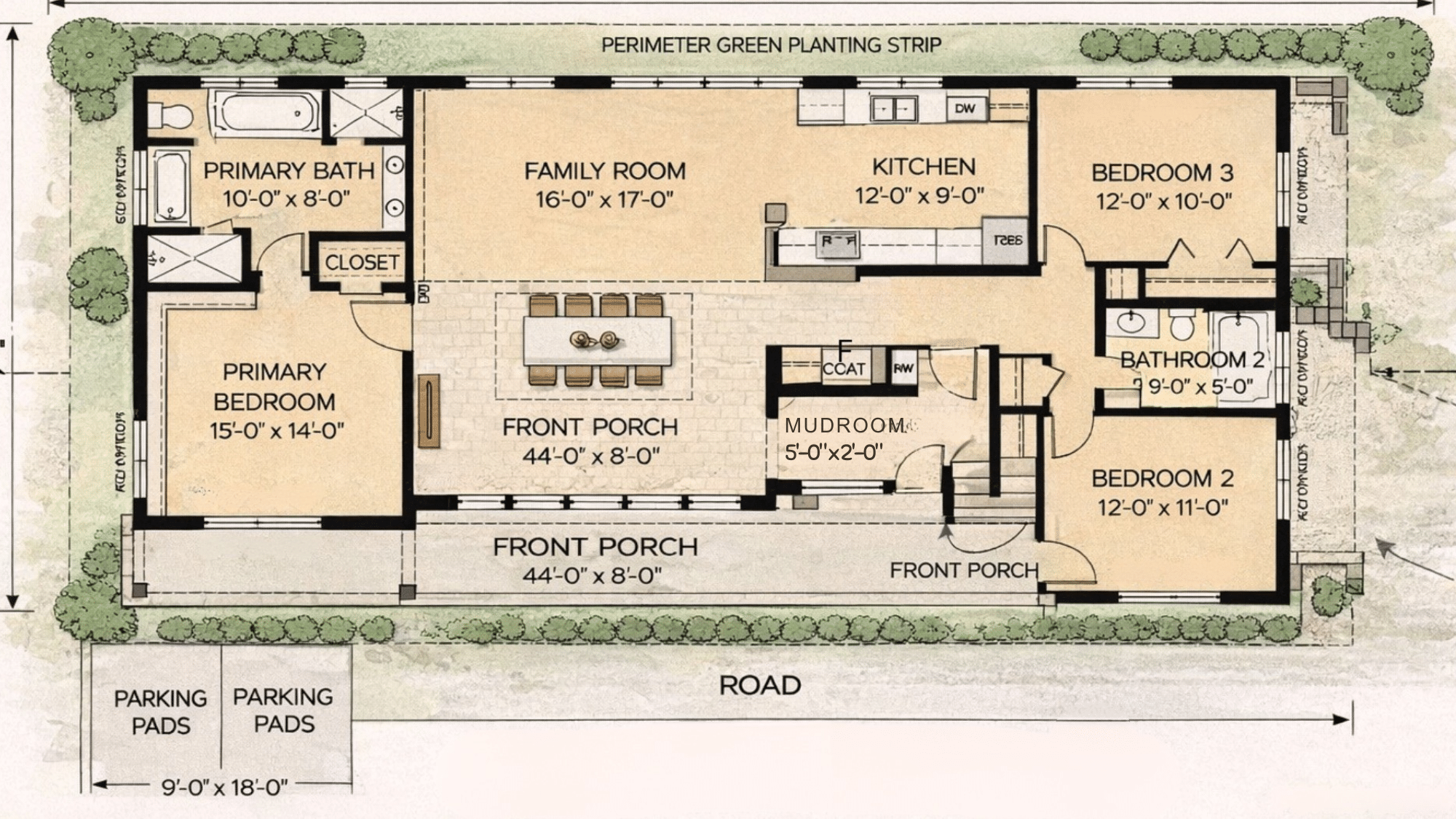
This is a single-story farmhouse-style floor plan with an extended front porch along the bottom.
The main entry leads into a large family room in the center. The kitchen sits to the right of the family room, set up in a straight line.
The primary bedroom is on the left side. It connects to a primary bath and a closet. Two more bedrooms are on the right side. Bedroom 2 and Bedroom 3 sit near a shared bathroom.
A small mudroom or drop zone is near the entry. It adds storage space for coats and daily items. Parking pads are shown at the bottom left. A green planting strip wraps around the outside edge of the home.
8. Duplex or ADU-ready plan
This floor plan shows a duplex. It is split into two mirror-image homes with a shared wall down the middle.
Each side has its own covered entry. You step into a living room that connects to the kitchen and dining area.
Bedrooms are located in the lower half of each unit. The bedrooms are grouped around a small central hall, which also houses closets and bathrooms.
Each home has private patios. Some are along the top edge, and more along the bottom, giving each unit its own outdoor space.
Parking pads are shown near the road at the bottom. Green planting strips wrap around the site edges.
Concrete House Construction: What Your Plans Must Include
Concrete construction relies on detailed, accurate plans. Before moving forward, make sure your house plans include the information builders and inspectors need to avoid delays and added costs.
| WHAT TO CHECK | MUST INCLUDE | WHY IT MATTERS |
|---|---|---|
| Wall system | Clear callout: ICF / CMU / poured-in-place | A builder can price and build correctly |
| Structural + rebar | Rebar size, spacing, placement, key wall notes | Avoids extra engineering and surprises |
| Openings | Lintels + window/door bucks/blocking details | Prevents delays and change orders |
| Roof tie-ins | Connector type + spacing + embedment details | Critical for wind/storm safety |
| Utilities | Routing plan: chases/conduits/furring | Concrete is hard to modify later |
| Insulation | Where/how insulation is added (R-values if possible) | Impacts comfort + code compliance |
| Climate + code | Wind/seismic/frost + energy code notes | Helps pass permits faster |
| Complete set | Floors, elevations, sections, foundation details | Reduces assumptions on site |
| Lifestyle fit | Layout flow + outdoor access | Ensures the plan works for you long-term |
Plans that include these details reduce guesswork and keep construction moving smoothly. Verifying them early helps avoid delays, change orders, and unexpected costs later in the build.
Ready to Build with Concrete?
The right concrete house plans set your project up for success from day one. You now understand what makes these plans different and why those details matter.
Concrete homes require more upfront planning than wood-frame construction. Your plans need complete structural details, precise wall system specifications, and proper utility routing. Missing information leads to delays and extra costs during building.
Take time to find plans that match your climate, lifestyle, and budget. Review them carefully with an experienced concrete builder. Make sure every technical detail is included before you start construction.
The extra planning effort pays off for decades. Your concrete home will stand firm through storms, stay quieter inside, and need minimal maintenance over the years you own it.
Start with solid plans. Build with confidence. Live in a home designed to last.